All techniques
Framing & context
The gross figure
Counted on the way in. Nobody counted what went back out.
a.k.a. gross versus net · gross orders · gross bookings · gross adds · before returns · before cancellations · inflow only · new sign-ups without churn · one side of the ledger
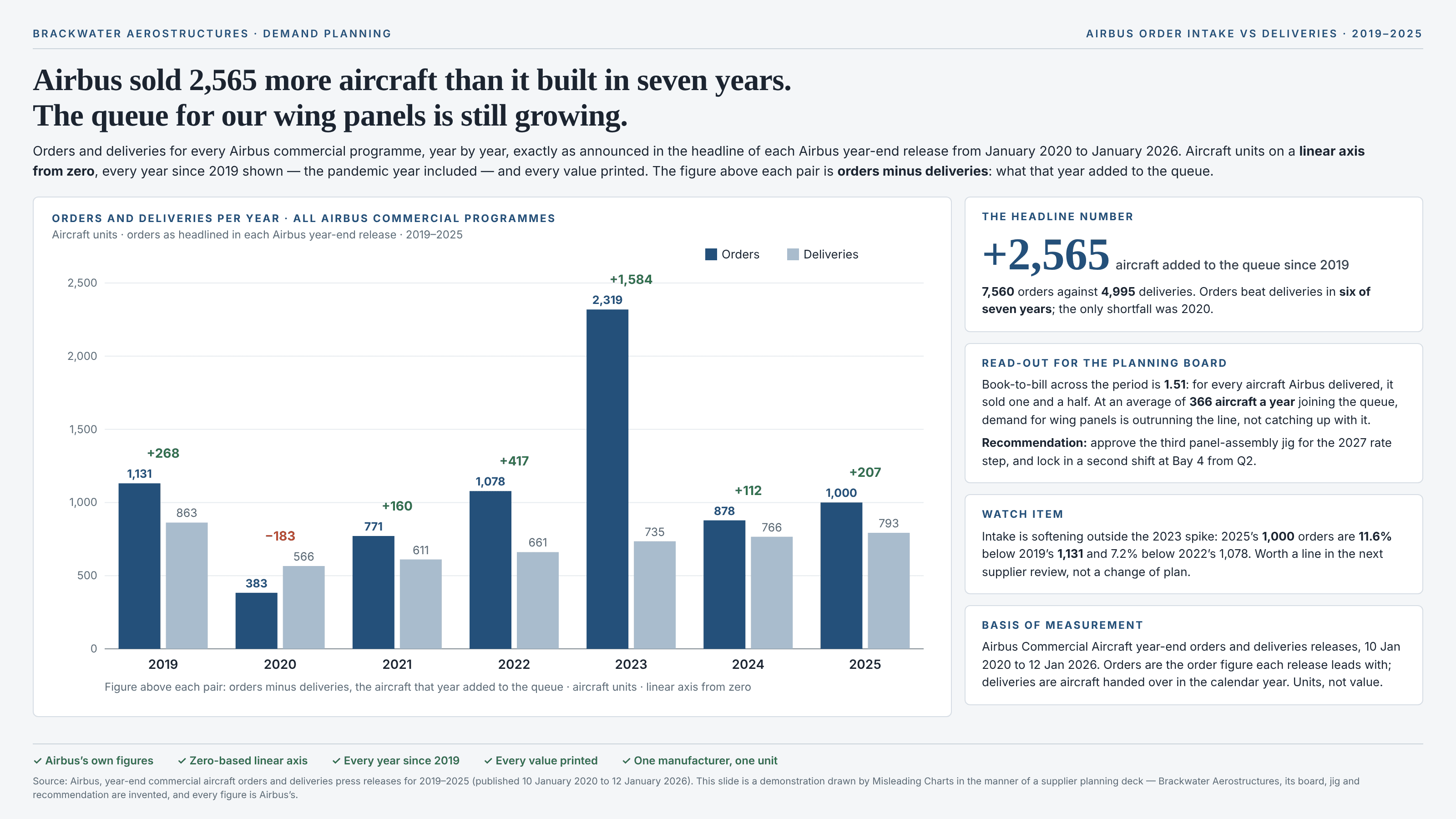
Plenty of quantities have a door at each end: orders come in and get cancelled, customers sign up and leave, goods are sold and come back, jobs are created and lost. Many sources — order books and labour-market statistics among them — report both sides and a net figure besides, and the gross number is often the one quoted first. A chart that takes the gross figure and then asks a net question — is the order book growing, is the customer base bigger, did we keep the sales — has counted every arrival and none of the departures. Nothing on it is wrong. Every bar is the number the source printed, the axis can be impeccable, and the period complete. The error is in what the bar is set against: subtract deliveries from gross orders, or read rising gross sign-ups as a growing customer base, and the outflow that happened in the same year simply never reaches the arithmetic. It does the most damage where the outflow is lumpy, because then the gross series keeps its shape while the net one does not: a year with a wave of cancellations looks like a strong year, the ranking of years can turn over completely, and a stock that shrank is drawn as one that grew. Keep it apart from the missing denominator, which leaves out the size of the thing being counted; here the size is fine, and what is missing is the subtraction.
How to spot it
- Read the source’s own headline. Order books, subscriber counts, returns-heavy retail and labour-market flows nearly always print gross and net side by side; if the chart quotes only one, find out which.
- Ask which way the question points. “How much did we sell?” is a gross question. “Is the backlog, the customer base or the headcount bigger than it was?” is a net question, and a gross figure cannot answer it.
- Do the stock check. If the chart implies a stock grew by X, look up the stock at both ends. When the reported stock moved by much less than X, something left by a door the chart did not draw.
- Look for a ratio or a growth claim built on the gross side: book-to-bill on gross orders, gross adds quoted as subscriber growth, sales before returns per store. Gross on top with a real outflow left out flatters every period by the same mechanism.
- Watch the years with a known shock — a programme ended, a price rose, a customer went bust. That is when departures bunch up, and when the gross line stays smooth while the net line falls through it.
- Words like “new”, “signed”, “booked”, “added” and “won” describe the way in. “Net”, “after cancellations” and “after churn” describe the balance. A chart titled with the first kind and captioned with conclusions about the second is the tell.
The fix
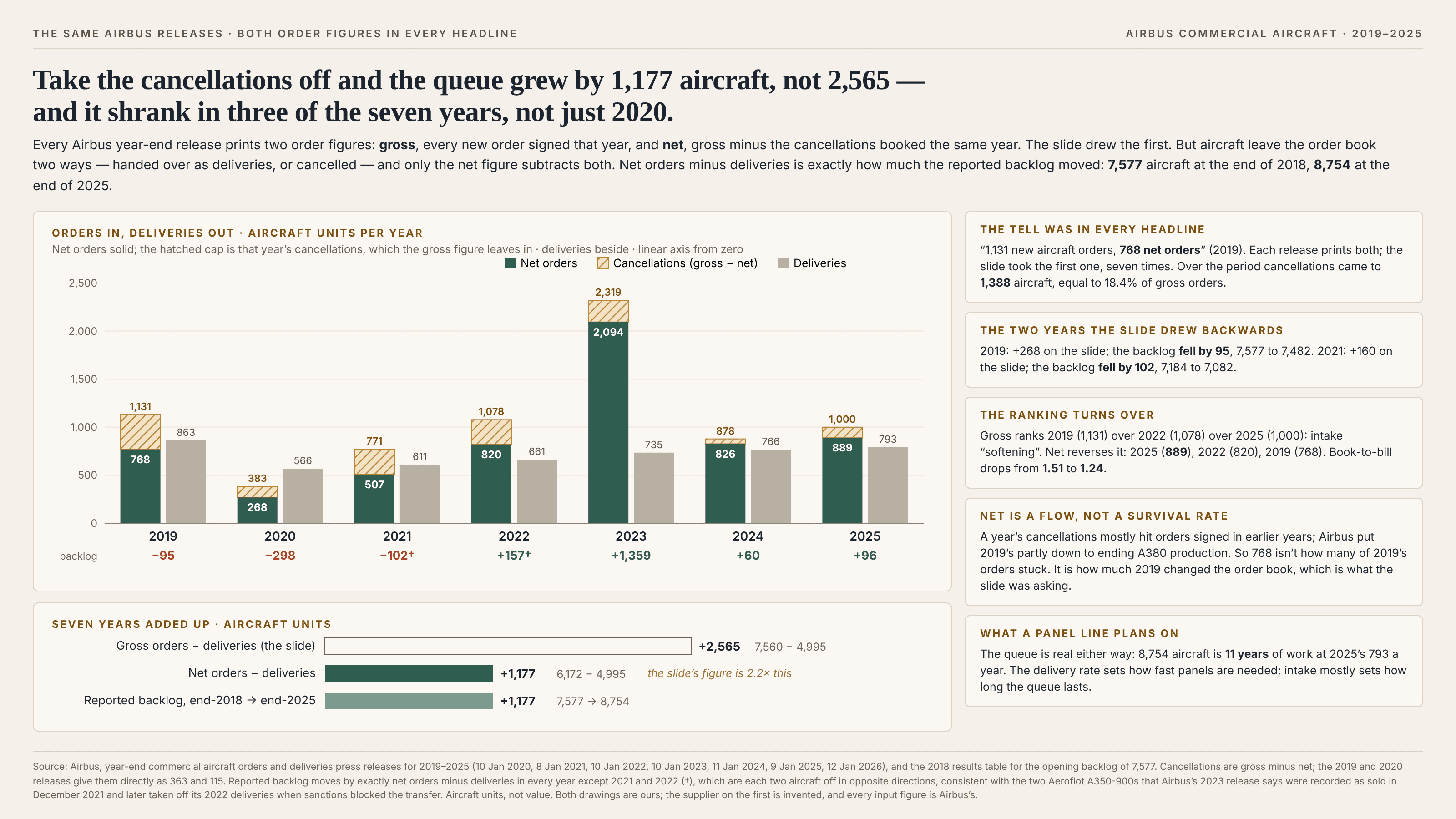
Draw both sides of the ledger, and make the net figure the solid one. The simplest honest chart stacks it: the net part of each bar in full ink, with the outflow as a lighter or hatched cap on top, so the gross figure is still there to read but no longer passes for the result. If the question is about a stock, reconcile to the stock: show that opening level plus net inflow minus the other outflows lands on the closing level the publisher reports, and say in the caption how close it comes. A reconciliation that closes is good evidence that no flow has been left out of the arithmetic, though it says nothing about scope. Be careful what net means, too. This year’s cancellations or departures usually belong to arrivals from earlier years, so net inflow is not the share of this year’s arrivals that stayed; it is how much the year changed the stock. That is the right quantity for “is it growing?” and the wrong one for “how good were this year’s sales?”, which needs the arrivals followed as a cohort. And keep gross for the questions it does answer — how busy the sales team was, how much paperwork came through the door — with the word “gross” on the axis rather than in the footnote.
In the gallery