All techniques
Framing & context
Relative risk without the baseline
“Raises your risk 18%.” Of what, from what, by how many?
a.k.a. relative vs absolute risk · the naked percentage increase · missing baseline risk · risk ratio · hazard is not magnitude
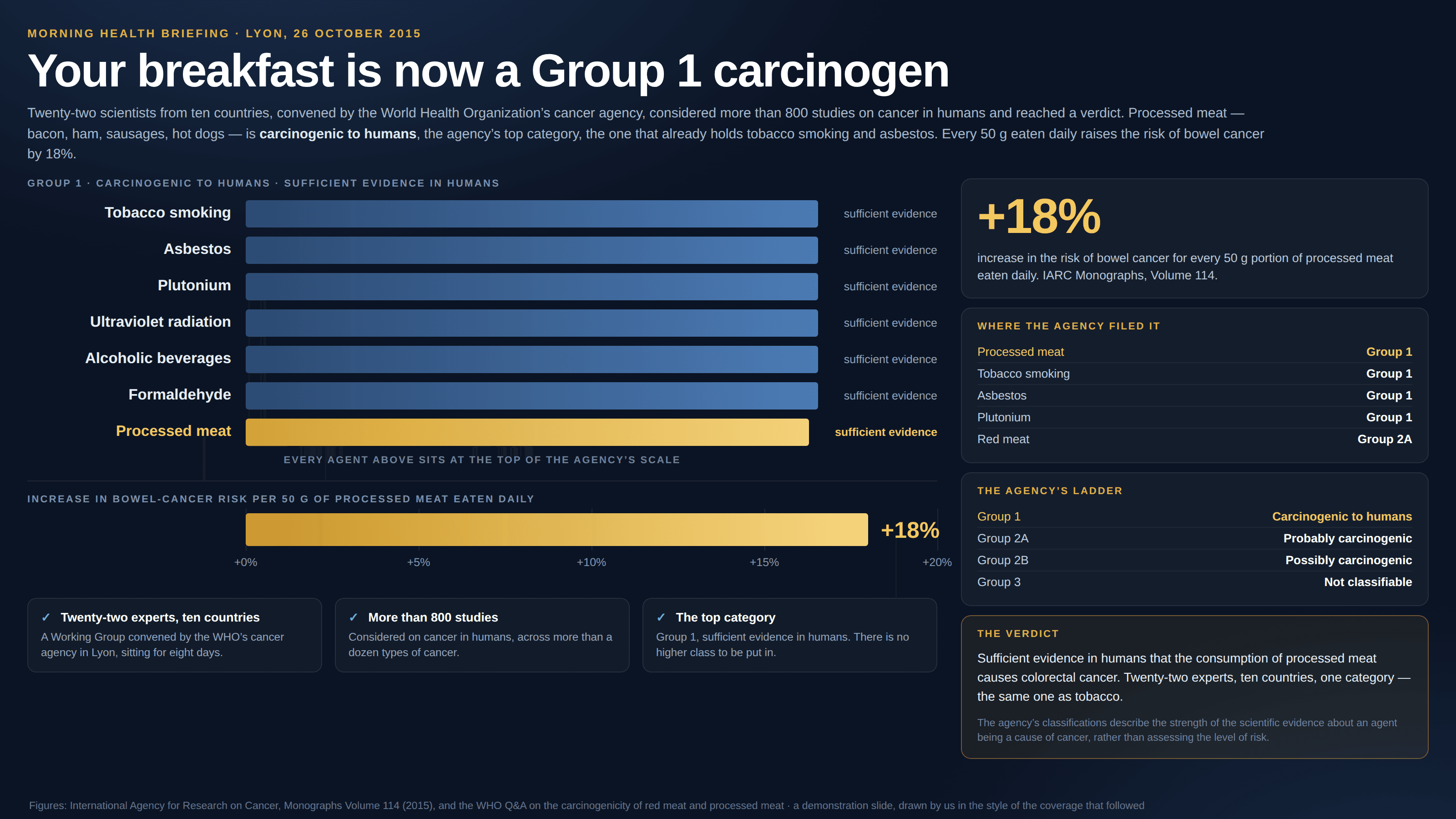
A percentage increase is a ratio, and a ratio means nothing until you know what it multiplied. Eighteen percent more of a one-in-a-million chance and eighteen percent more of a coin flip are the same number on the page and different worlds to live in. Charts drawn in ratio space — axes labelled “% increased risk”, indexes pinned to 100, bars whose height is a change rather than an amount — cannot show the baseline, because the baseline is not on the axis. The reader supplies it from imagination, and imagination runs high.
How to spot it
- Read the axis label. “% increase”, “× risk”, “relative to baseline” — nothing on that axis is a quantity of anything.
- Ask “increase from what?” If the chart, the caption and the press release all decline to say, that silence is the finding.
- A multiplier with no denominator in sight: “doubles”, “50% more likely”, “three times the risk”.
- Rare outcomes make the most quotable multipliers, so the biggest ratios tend to sit on the smallest baselines.
- A category being read as a quantity: a classification says whether something causes an outcome, never how much of it.
The fix
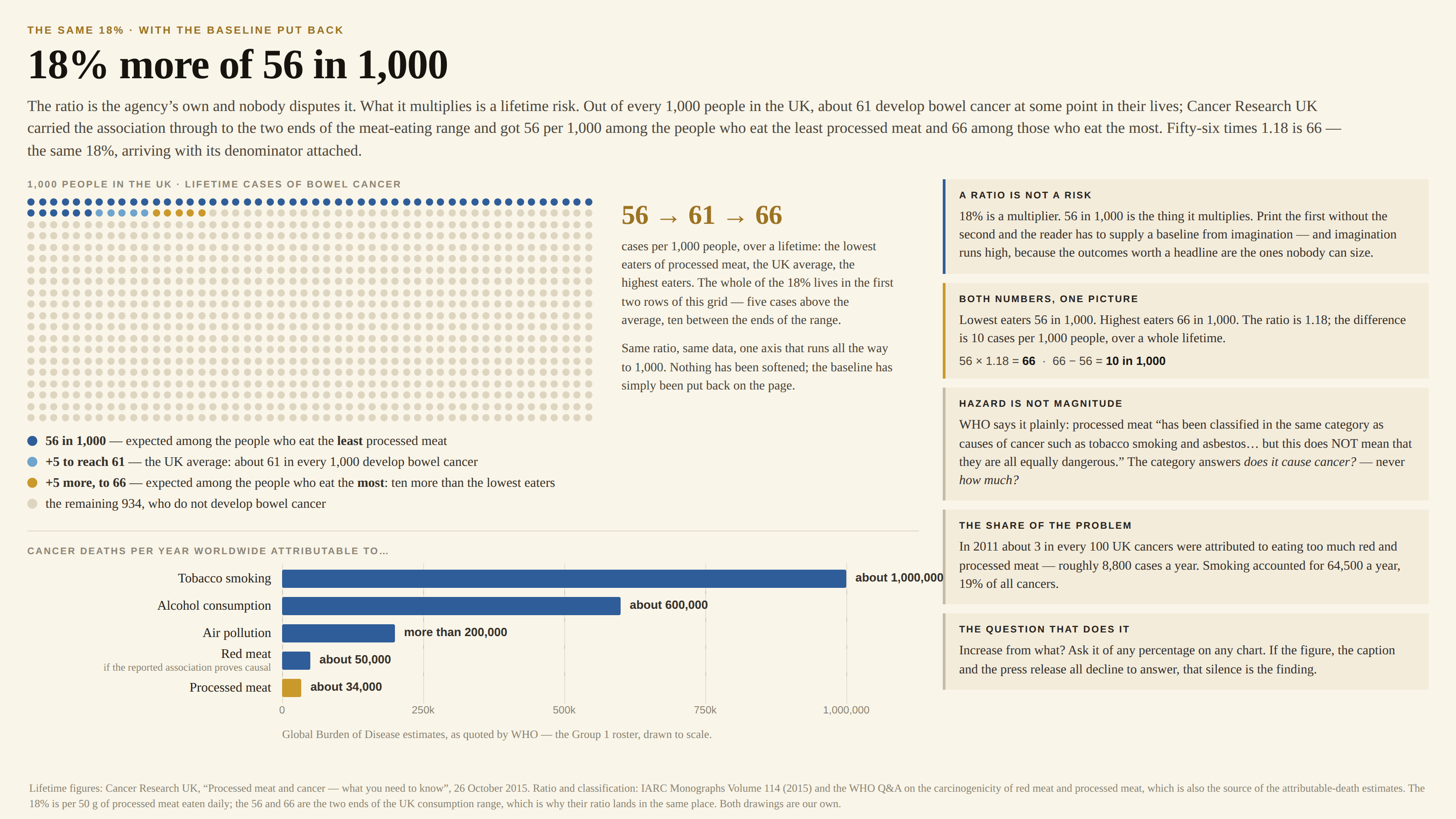
Put both risks on one absolute scale and let the reader see the gap and the ground it stands on — 61 in 1,000 against 66 in 1,000, on an axis that runs to 1,000. An icon array of a hundred or a thousand does that in a single picture. Give the difference as well as the ratio: the difference is the number a person can act on, and it is the one the ratio hides. Keep the ratio too — it is the right way to carry an effect across populations with different baselines — just never let it travel alone. And when the chart is really about a classification, plot the magnitudes underneath it, because a category and a quantity are different questions and only one of them has a scale.
In the gallery