All techniques
Size & scale
The word cloud
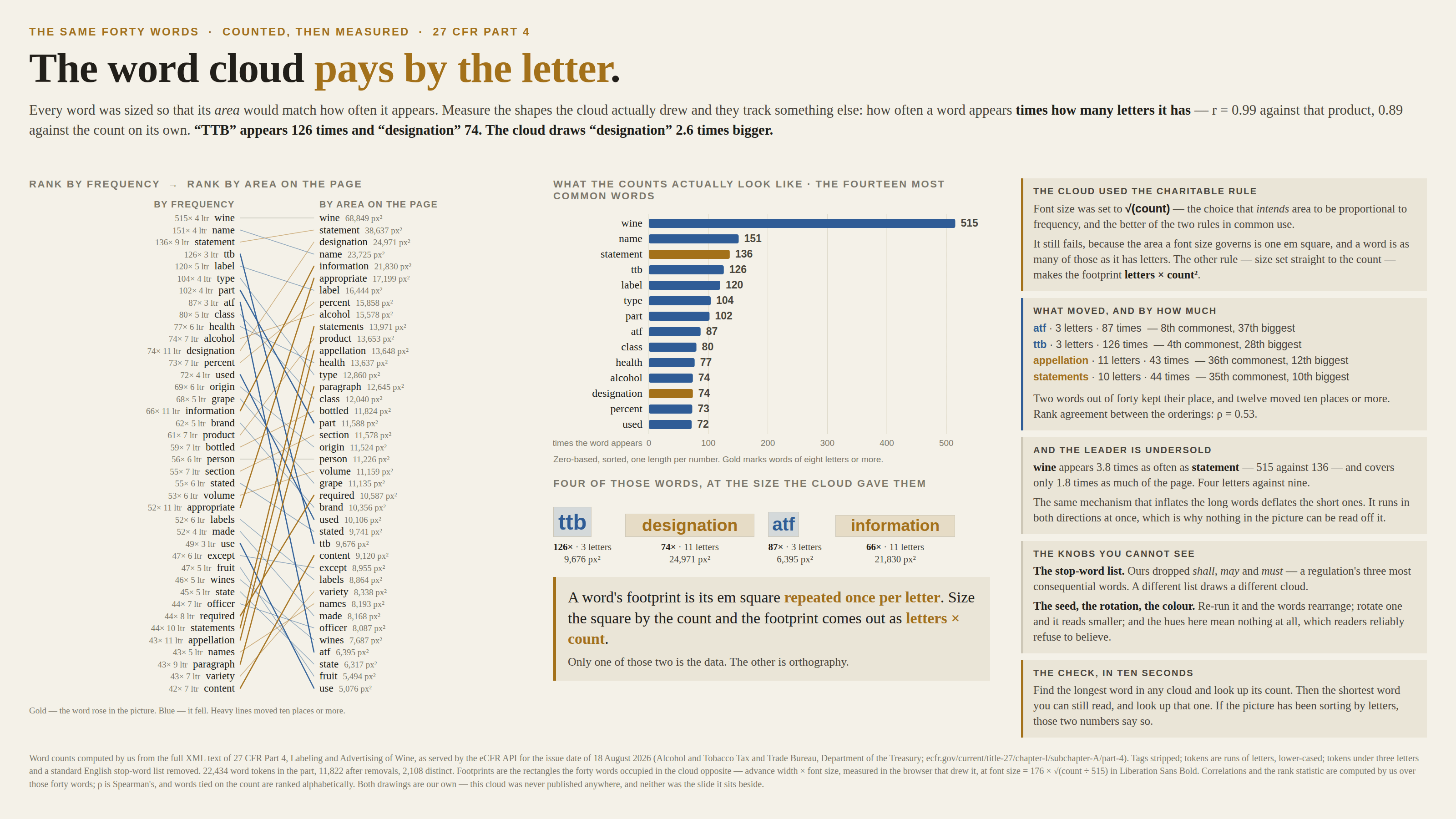
The biggest word is usually just the longest one.
a.k.a. tag cloud · wordle · text cloud · the free-text summary · the open-ended question, visualised
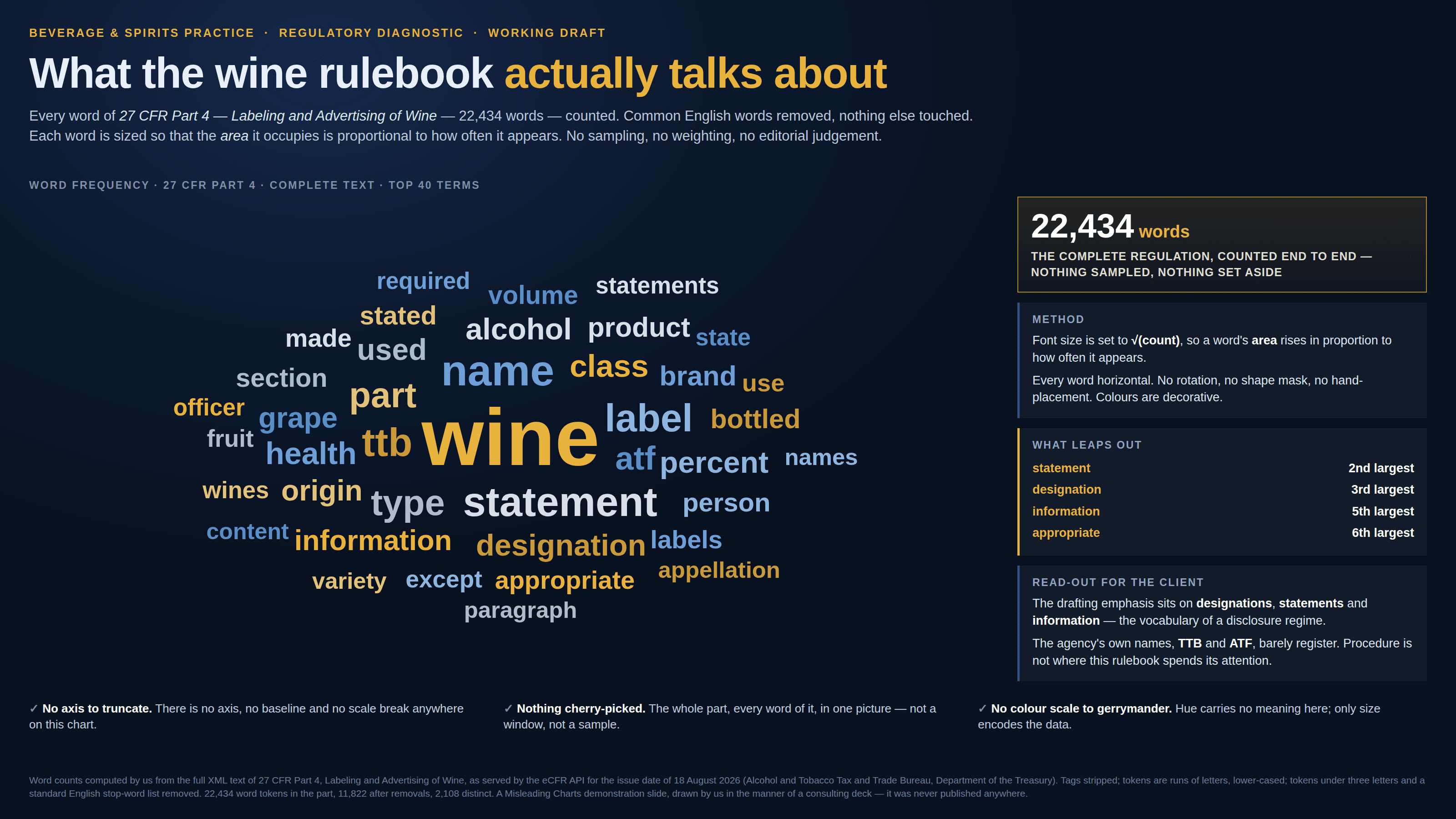
A word cloud asks the eye to rank quantities by how big the words look, and a word’s size on the page is set by two things, only one of which is the data. The font size carries the frequency; the letter count carries nothing at all. A word’s footprint is its em square repeated once per letter, so what the reader actually measures is frequency times length — and an eleven-letter word at half the count reliably outdraws a three-letter one. Even the charitable sizing rule, font size set to the square root of the count, which is trying to make area track frequency, only ever governs one of the two dimensions. Around that sit the knobs nobody declares: a stop-word list that decides which words exist at all, a layout seed that rearranges the picture on every run, rotation that shrinks whatever it turns, and colour that usually means nothing while the eye goes on looking for its meaning.
How to spot it
- Find the longest word in the picture and look up its count. Then the shortest word you can still read, and look up that one. If the ranking has been sorting by letters, those two numbers say so.
- A short, plain term you would expect near the top — an acronym, a name, a code — sitting small or missing entirely.
- Ask what the stop-word list removed. In a legal text it is usually “shall”, “may” and “must”, which is to say the verbs that do the work.
- Rotated words. A word turned on its side reads as smaller than the same word lying flat, and nothing about the data turned it.
- Colour with no key. If nothing on the page says what the hues mean, they mean nothing — which does not stop anyone from ranking them.
- No numbers anywhere. Clouds almost never print a count, so the claim being made cannot be checked against the chart making it.
The fix
A bar chart of the counts, sorted, on one zero-based axis: one length per number, and no second dimension for spelling to get into. It is duller, and the dullness is the finding — free text is usually one dominant term and a long flat tail, which a cloud cannot show because it has no axis to show it on. Print the numbers next to the bars, and say which stop-word list you used, since that list is half the result. If what actually matters is which words travel together rather than how often each one turns up, then the question was never a frequency question: reach for phrases, co-occurrence, or a dozen quoted responses, all of which answer it and none of which a cloud can. And where a cloud is wanted as decoration, let it be decoration — put it beside the chart that carries the numbers rather than in place of it.
In the gallery