All techniques
Cherry-picking
The filter that invents a trade-off
Two things that go together, sliced until they look like a choice.
a.k.a. Berkson’s paradox · collider bias · conditioning on a collider · selection-induced correlation · explaining away · collider stratification bias · the admitted-sample trade-off · the budget trade-off
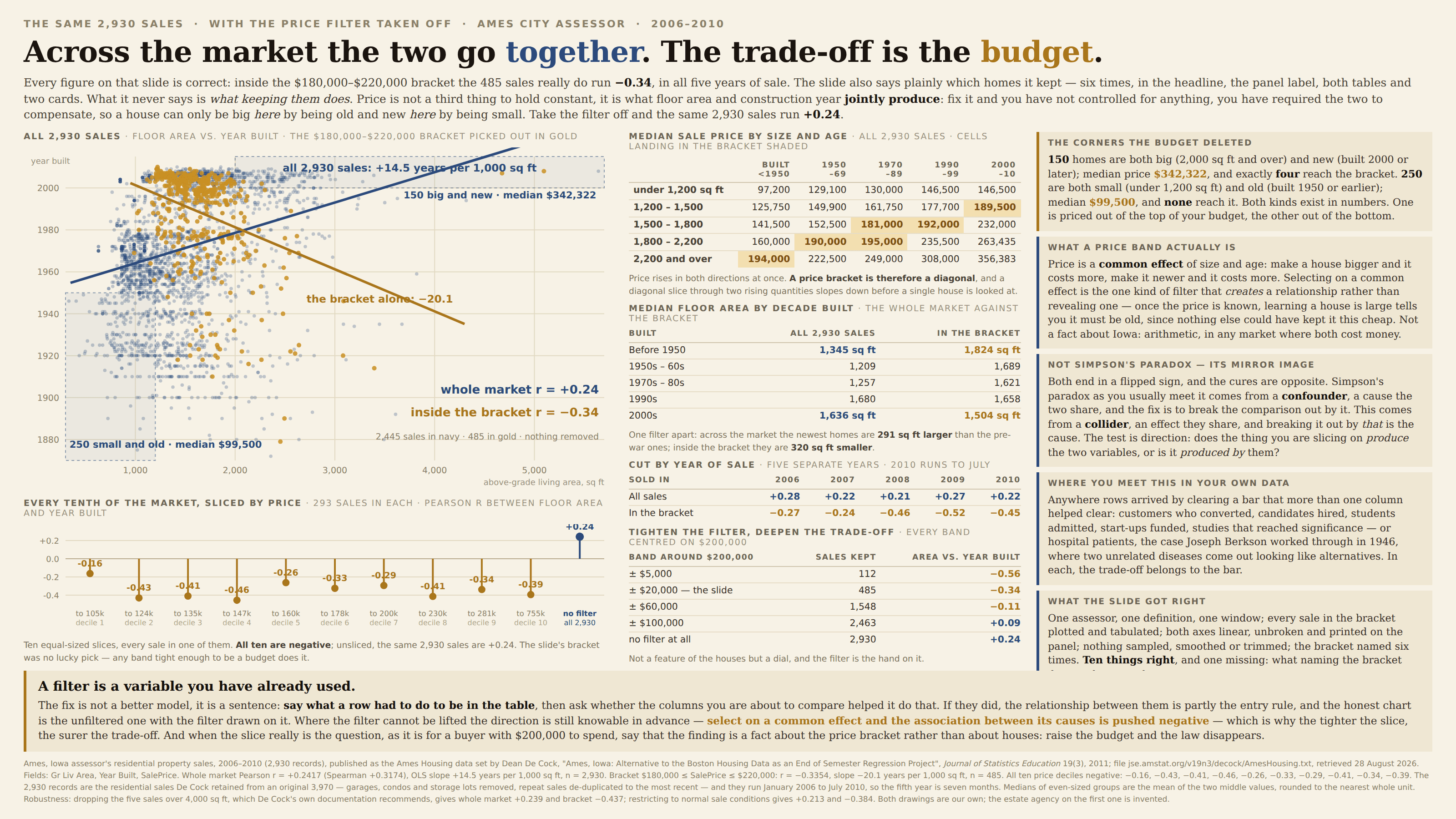
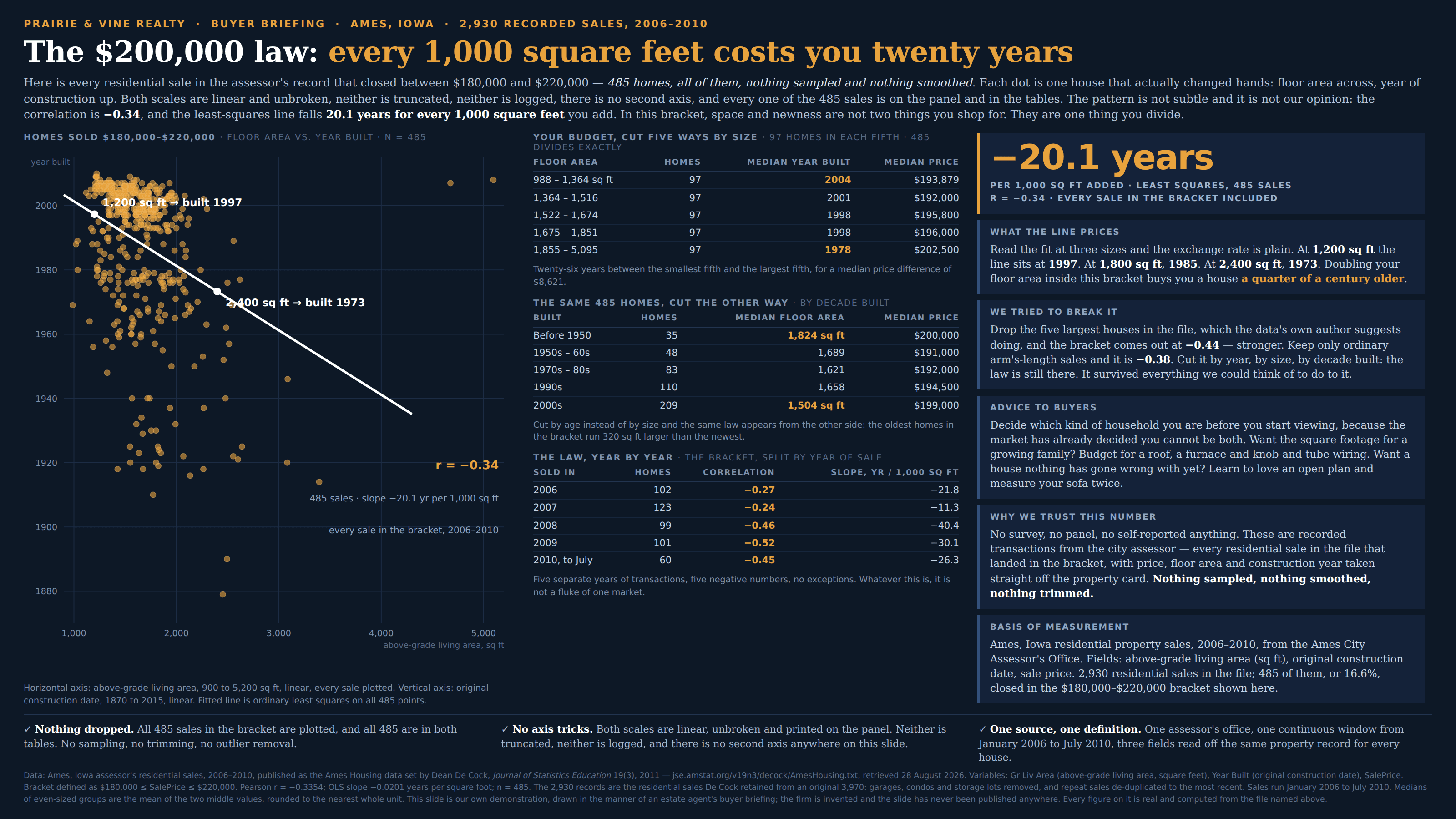
Some things are worth holding constant and some things are made of the very quantities you are comparing. Price is made of size and quality; getting hired is made of experience and interviewing well; reaching significance is made of sample size and effect size. Slice a dataset by one of those and you have not controlled for anything — you have required the parts to compensate for each other, because the only way into the slice with less of one is more of the other. The two then appear to trade off inside the slice however unrelated, or however positively related, they are outside it. Nothing is exaggerated, nothing is omitted from the chart, and the correlation is computed correctly. The finding is simply about the entry rule rather than about the world.
How to spot it
- Ask what a row had to do to be in this table, then ask whether the two columns you are comparing helped it do that. If they did, the relationship between them is partly the entry rule.
- A trade-off between two things that are both plainly good, inside a group that was selected — the funded start-ups, the admitted students, the hired candidates, the published studies, the homes you can afford.
- The word “among”. Among Olympians, among hospital patients, among best-sellers: the qualifier names the filter, and the filter is doing the arguing.
- Draw the two-by-two and find the empty corner. A genuine trade-off thins out both extremes; a filter deletes exactly one corner — the one that could not clear the bar — and sometimes the opposite one too.
- Tighten the slice and watch. If narrowing the band deepens the negative relationship and widening it brings the positive one back, the relationship is a dial and the filter is the hand on it.
- Check the direction of the arrows. If the thing you sliced on is caused by your two variables rather than causing them, you have conditioned on a collider and manufactured the result.
- A “surprising” negative correlation in an elite or pre-qualified population, reported without the unfiltered population beside it.
The fix
Take the filter off and look, because the unfiltered scatter with the filter drawn on it is the whole explanation in one picture: the slice is a diagonal, and the corners it deleted are visible sitting outside it. Where the filter cannot be lifted — the rows that failed to convert were never recorded, the rejected applicants were never measured — the direction is still knowable in advance, which is the most useful thing about this one: selecting on a common effect pushes the association between its causes negative, so you can say which way a filtered number leans before you have seen it — and why a tighter slice makes a surer-looking trade-off. Say what a row had to do to be in the table, in a line on the chart, the way you would name a unit. And keep the distinction from Simpson’s paradox sharp, because the two look identical on the page and want opposite treatment: Simpson’s paradox as you usually meet it comes from a confounder, a cause the two variables share, and you fix it by breaking the comparison out by it; a collider is an effect they share, and breaking the comparison out by that is what caused the trouble. The test is a question about direction rather than about statistics — does this thing produce my two variables, or is it produced by them? Finally, when the slice genuinely is the question, as it is for anyone with a fixed budget or a fixed shortlist, keep the finding attached to the slice: it is a fact about the bracket, not about the population, and it will not survive the bracket moving. Be warned that the usual reassurances will not catch it — split the filtered data by year, drop its outliers, rerun it on a cleaner subset, and every check comes back agreeing, because the filter is still there in every one of them.
In the gallery